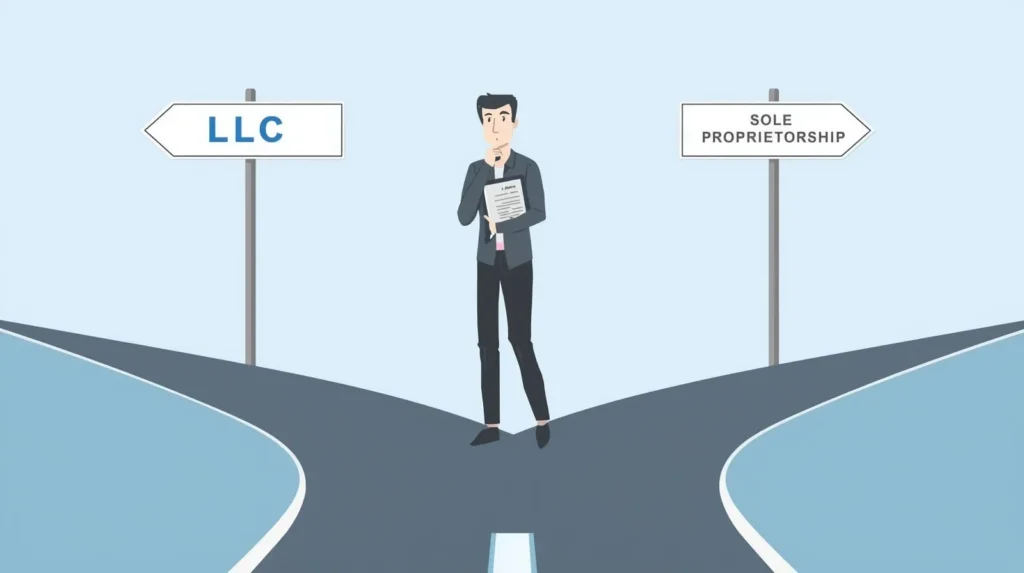
Choosing between an LLC and a sole proprietorship is one of the first big decisions new business owners face.
At first, the difference may not seem important. You may think, “I just want to start selling, getting clients, and making money.” That is understandable.
But your business structure affects your personal risk, taxes, paperwork, banking, credibility, and long-term growth.
A sole proprietorship is the simplest way to start a business. In many cases, you automatically become a sole proprietor when you start doing business by yourself without forming a legal entity.
An LLC, or Limited Liability Company, takes more effort to set up, but it gives your business a separate legal identity.
So which one is better?
For very small, low-risk businesses, a sole proprietorship may be enough in the beginning.
But for most serious business owners who want liability protection, a professional image, and room to grow, an LLC is usually the better choice.
This guide breaks down LLC vs sole proprietorship in simple terms so you can decide what makes sense for your business.
Quick Answer: LLC vs Sole Proprietorship
A sole proprietorship is easier and cheaper to start, but it does not separate you from your business legally. You are personally responsible for business debts, lawsuits, and obligations.
An LLC costs more and requires state filing, but it creates a separate legal business entity. This can help protect your personal assets and make your business look more professional.
If you are testing a small side hustle with very little risk, a sole proprietorship can work.
If you are serious about building a business, working with clients, signing contracts, selling products, hiring people, or protecting personal assets, an LLC is usually better.
What Is a Sole Proprietorship?

A sole proprietorship is the simplest business structure.
It means one person owns and operates the business without forming a separate legal entity.
For example, if you start freelancing under your own name, sell handmade products online, offer consulting services, or do local work without creating an LLC or corporation, you may already be operating as a sole proprietor.
There is usually no formal state formation process for a basic sole proprietorship.
That is why many beginners start this way.
It is simple. It is cheap. It has very little paperwork.
But the biggest weakness is liability.
With a sole proprietorship, you and the business are legally the same in many situations. If the business owes money, gets sued, or creates a legal problem, your personal assets may be at risk.
That can include your personal savings, car, home, and other property.
This is the main reason many business owners eventually move from a sole proprietorship to an LLC.
What Is an LLC?

An LLC is a legal business entity created under state law.
Unlike a sole proprietorship, an LLC is separate from the owner.
That separation is the main benefit.
If your LLC has debts or legal claims, your personal assets are generally separated from the business, as long as you run the LLC properly.
An LLC can be owned by one person or multiple people.
A one-owner LLC is called a single-member LLC. An LLC with two or more owners is called a multi-member LLC.
LLCs are popular because they are flexible. They are usually easier to manage than corporations, but they offer more protection and structure than sole proprietorships.
You can use an LLC for freelancing, consulting, eCommerce, real estate, digital products, agencies, local services, online businesses, and many other business types.
LLC vs Sole Proprietorship: Simple Comparison Table
| Feature | Sole Proprietorship | LLC |
|---|---|---|
| Legal entity | Not separate from owner | Separate legal entity |
| Personal liability protection | No | Yes, if managed properly |
| Startup cost | Very low | State filing fee required |
| Paperwork | Minimal | More paperwork |
| Taxes | Reported on owner’s return | Flexible tax options |
| Business bank account | Possible, but less formal | Strongly recommended |
| Professional image | Basic | More professional |
| Best for | Very small, low-risk businesses | Serious businesses and growing brands |
| State filing | Usually not required | Required |
| Ongoing compliance | Low | Depends on state |
Main Difference Between an LLC and a Sole Proprietorship

The main difference is legal separation.
A sole proprietorship does not create a separate legal business entity.
An LLC does.
This matters because legal separation can protect your personal assets.
Let’s say you run a small marketing business as a sole proprietor. A client claims your work caused them financial damage and decides to sue. Since there is no separate legal entity, you may be personally responsible.
Now imagine you run the same business through an LLC. The claim would generally be against the LLC, not you personally.
That does not mean an LLC protects you from everything. It does not protect you from fraud, personal wrongdoing, unpaid personal guarantees, or mixing personal and business money.
But it does create a stronger wall between your personal life and your business.
That wall is one of the biggest reasons people choose an LLC.
Startup Cost: Which Is Cheaper?
A sole proprietorship is cheaper to start.
In many cases, you can begin operating without paying a state formation fee.
You may still need a business license, local permit, DBA, or sales tax registration depending on your location and business type. But the basic structure itself is usually free or very cheap.
An LLC costs more because you must file formation documents with your state.
This filing fee varies by state. Some states are affordable. Others charge hundreds of dollars.
You may also pay for a registered agent, operating agreement, LLC formation service, or attorney if needed.
So, if your only concern is startup cost, a sole proprietorship wins.
But cheaper does not always mean better.
If your business has any risk, contracts, customer complaints, debt, or liability exposure, saving a small amount upfront may not be worth the personal risk.
Liability Protection: Which Is Safer?
An LLC is usually safer.
This is the biggest advantage of an LLC over a sole proprietorship.
With a sole proprietorship, there is no legal wall between you and your business. If your business is sued or owes money, you may be personally responsible.
With an LLC, the business is a separate legal entity. This can help protect your personal assets from business liabilities.
For example, if your LLC cannot pay a business debt, creditors usually go after the LLC’s assets first, not your personal bank account.
But you must run the LLC correctly.
That means keeping separate bank accounts, signing contracts in the LLC’s name, keeping records, following state rules, and avoiding personal use of business funds.
I’ve seen many people make this mistake. They form an LLC, then use one bank account for everything. They pay groceries, rent, ads, software, and client refunds all from the same account.
That weakens the protection.
An LLC is only useful if you treat it like a real business.
Taxes: Which One Is Better?
This is where many beginners get confused.
A sole proprietorship is simple for taxes. Business income is usually reported on the owner’s personal tax return. You may also pay self-employment tax.
A single-member LLC is usually taxed the same way by default. The IRS generally treats it as a disregarded entity unless the owner chooses a different tax classification.
That means an LLC does not automatically reduce taxes just because it is an LLC.
This surprises many people.
The real tax advantage of an LLC is flexibility.
An LLC may choose to be taxed as an S corporation or C corporation if it qualifies. An S corporation election may help some profitable businesses reduce self-employment tax, but it also adds payroll, tax filings, bookkeeping, and more rules.
To be honest, most beginners do not need an S corp election on day one.
If you are just starting, focus on clean bookkeeping first. Track income. Track expenses. Save for taxes. Then talk to an accountant once the business has steady profit.
For basic tax simplicity, a sole proprietorship is easier.
For long-term tax flexibility, an LLC is better.
Paperwork and Compliance
A sole proprietorship is easier to manage.
There is no LLC formation document, no operating agreement requirement, no annual LLC report in many cases, and less formal compliance.
You may still need licenses, permits, tax registrations, and DBA filings, but the business structure itself is simple.
An LLC requires more paperwork.
You need to file formation documents with the state. You may need an operating agreement. You may need to file annual or biennial reports. You may need to maintain a registered agent.
Some states also charge annual fees or franchise taxes.
This is the tradeoff.
A sole proprietorship is easier.
An LLC gives more structure and protection.
If you hate paperwork and your business is very small, sole proprietorship may feel easier. But if you want a serious business, the extra LLC paperwork is usually worth it.
Business Credibility
An LLC often looks more professional.
Clients, banks, vendors, affiliate networks, payment processors, and business partners may take an LLC more seriously than a sole proprietorship.
For example, “BrightPath Consulting LLC” may look more established than someone simply operating under their personal name.
This does not mean sole proprietors cannot build strong businesses. Many do.
But an LLC gives your business a more official identity.
This can help when opening a business bank account, signing contracts, applying for business credit, working with larger clients, or building a brand.
If you are trying to win serious clients, an LLC can make a better first impression.
Banking and Business Finances
Both sole proprietors and LLC owners can open business bank accounts, but LLC banking is usually cleaner.
With an LLC, you should always open a separate business bank account.
This helps protect your liability shield, organize taxes, and separate personal and business finances.
A sole proprietor can also open a business account, especially with a DBA. But many beginners skip it and keep using their personal account.
That creates messy records.
No matter which structure you choose, separate your money.
Do not mix personal spending with business income.
This is one of the simplest ways to keep your business organized.
Ownership Differences
A sole proprietorship can only have one owner.
If you want to start a business with another person, a sole proprietorship does not work.
You may need a partnership, LLC, or corporation.
An LLC can have one owner or multiple owners.
This makes it more flexible.
If you are starting alone, either structure can work. If you have a partner, an LLC is usually the better option because it allows you to define ownership percentages, management rights, profit sharing, and exit rules.
For multi-owner businesses, an operating agreement is very important.
Do not rely on verbal promises.
Put everything in writing.
Risk Level: When a Sole Proprietorship May Be Enough?
A sole proprietorship may be enough if your business is very small, simple, and low-risk.
For example, you may start as a sole proprietor if you are testing a blog, doing small freelance work, selling digital templates, offering basic writing services, or trying a side hustle with no major contracts or liability risk.
It can also work if you have very little income and are not ready to pay state filing fees.
But you should review the structure once the business starts making money.
A sole proprietorship is not always a bad choice. It is just limited.
It works best when your risk is low and your business is still in the testing stage.
When an LLC Is the Better Choice?
An LLC is usually better when your business has real risk or real growth potential.
Choose an LLC if you work with clients, sign contracts, sell products, rent property, hire workers, take business loans, use paid advertising, manage customer data, or operate under a brand name.
An LLC is also better if you want to separate personal and business assets from the start.
Here is a practical rule:
If losing a lawsuit, refund dispute, unpaid debt, or business mistake could hurt your personal finances, consider an LLC.
This applies to many businesses.
Consultants, agencies, coaches, contractors, eCommerce sellers, real estate owners, affiliate marketers, and local service providers often benefit from having an LLC.
Does an LLC Protect Your Personal Assets Completely?
No.
An LLC can help protect personal assets, but it is not complete protection against every problem.
You can still be personally responsible if you personally guarantee a loan, commit fraud, mix personal and business finances, ignore legal requirements, or personally cause harm through negligence.
This is why good business habits matter.
Keep separate accounts.
Use contracts.
Maintain insurance.
Pay taxes.
Follow state compliance rules.
Sign documents under the LLC name.
The LLC gives you a legal structure, but your behavior keeps that structure strong.
Do You Need Insurance If You Have an LLC?
Yes, in many cases.
An LLC and insurance solve different problems.
An LLC creates legal separation between you and the business.
Insurance helps pay for certain claims, damages, legal costs, or accidents.
For example, if a customer sues your business, the LLC may help protect your personal assets. But insurance may help cover legal defense costs or settlement expenses.
Many business owners need general liability insurance, professional liability insurance, commercial auto insurance, property insurance, or workers’ compensation.
Do not assume an LLC replaces insurance.
It does not.
Can You Start as a Sole Proprietor and Later Form an LLC?
Yes.
Many business owners start as sole proprietors and later form an LLC.
This is common.
You may start simple to test your idea, then upgrade once the business makes money or takes on more risk.
When you move from sole proprietorship to LLC, you may need to file LLC formation documents, get an EIN, open a new business bank account, update contracts, change payment processor details, update licenses, and move business operations under the LLC.
Do not just form the LLC and keep operating the old way.
Make the switch properly.
The goal is to have clients, payments, contracts, and expenses connected to the LLC.
Which Is Better for Online Businesses?
For online businesses, an LLC is often the better long-term choice.
This includes blogs, affiliate websites, SaaS tools, eCommerce stores, agencies, coaching businesses, online courses, YouTube channels, and digital service businesses.
Online businesses may seem low-risk, but they can still face legal issues.
For example, you may deal with refund disputes, copyright claims, advertising complaints, affiliate compliance issues, customer data concerns, contract problems, or platform payment holds.
If the business is just an experiment, a sole proprietorship may be fine at first.
But once it starts earning steady income, an LLC can make the business cleaner and safer.
Which Is Better for Freelancers?
Freelancers often start as sole proprietors.
That is normal.
If you are doing a few small projects, it may not make sense to form an LLC immediately.
But as your freelance income grows, an LLC becomes more useful.
If you work with bigger clients, sign contracts, outsource work, offer advice, manage ad budgets, build websites, or handle sensitive client information, an LLC can give you more protection and credibility.
It can also make you look more professional when sending invoices and signing agreements.
Which Is Better for Local Service Businesses?
For local service businesses, an LLC is usually better.
Local services often carry more risk.
Think about cleaning companies, contractors, repair businesses, landscaping, delivery services, event services, home improvement, mobile detailing, and similar businesses.
You may work on customer property, use tools, drive vehicles, hire workers, or deal with physical risks.
A sole proprietorship may expose your personal assets if something goes wrong.
An LLC, combined with proper insurance, is usually the smarter structure.
Which Is Better for Taxes?
For basic taxes, a sole proprietorship is simpler.
For flexibility, an LLC is better.
A sole proprietorship has fewer formal tax choices.
An LLC can be taxed like a sole proprietorship, partnership, S corporation, or C corporation depending on ownership and elections.
That flexibility can become useful as your business grows.
But do not form an LLC only because you think it automatically cuts taxes.
It does not.
The biggest reason to form an LLC is usually liability protection and business structure, not instant tax savings.
Pros and Cons of Sole Proprietorship
Pros
- Easy to start
- Low cost
- Minimal paperwork
- Simple tax filing
- Good for testing small ideas
- No state LLC formation fee
- Full control by one owner
Cons
- No personal liability protection
- Harder to bring in partners
- Less professional image
- Personal and business assets are legally connected
- Fewer tax flexibility options
- Harder to build business credit
- Riskier for growing businesses
Pros and Cons of LLC
Pros
- Personal liability protection
- Separate legal business entity
- Better professional image
- Can have one or multiple owners
- Flexible tax options
- Easier to open business accounts
- Better for contracts and growth
- Stronger structure for serious businesses
Cons
- State filing fee required
- More paperwork
- Ongoing compliance duties
- Registered agent may cost extra
- Annual reports may be required
- More setup steps than sole proprietorship
- Protection can be weakened if managed poorly
LLC vs Sole Proprietorship: Which Should You Choose?
Choose a sole proprietorship if you are testing a very small, low-risk idea and want the cheapest, simplest way to start.
Choose an LLC if you want liability protection, business credibility, cleaner finances, tax flexibility, and a stronger structure for growth.
For most serious businesses, the LLC is the better long-term choice.
A sole proprietorship is fine for testing.
An LLC is better for building.
If you are earning real money, signing contracts, dealing with customers, selling products, or taking business risks, forming an LLC is usually worth the cost and paperwork.
Final Thoughts
The choice between LLC and sole proprietorship depends on your business stage, risk level, budget, and goals.
A sole proprietorship is simple and cheap, but it gives you little protection.
An LLC takes more work to set up, but it gives your business a separate legal identity and can help protect your personal assets.
If you are just testing an idea with low risk, starting as a sole proprietor may be fine.
But if you are serious about your business, want to protect yourself, and plan to grow, an LLC is usually the better choice.
The best structure is the one that matches where your business is now and where you want it to go.